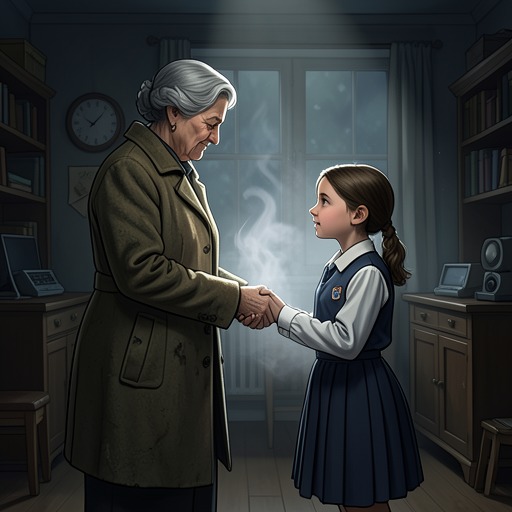
Flora and Elvy
Handling the UndeadFlora and Elvy are granddaughter and grandmother, but their bond becomes most visible not in a settled family life but in moments when the crisis overwhelms ordinary speech. After four days apart, they reunite at a public gathering where Elvy is struggling to deliver a message. Later, as violence engulfs the returned dead, Flora and Elvy find one another again, share what each understands, and choose to move toward the danger together. Their closeness offers neither a simple rescue nor a return to normality: the attempt to help is interrupted, and Flora already knows that what she has experienced cannot be undone.
Identity and Reunion
Flora recognizes Elvy’s voice before she sees her. When she looks up, her grandmother is on a stage, with Hagar standing behind her. The reunion comes after four days without seeing one another. Flora is so startled that she loses control of the Power; frightened thoughts flood in and drown out Elvy’s voice. She catches only a fragment about souls before Elvy is forced down from the stage. The moment makes their closeness immediate but not uncomplicated: Flora is desperate to hear her grandmother, while the crowd’s thoughts and the disruption around Elvy make listening almost impossible.
When Flora reaches her, the change in Elvy’s appearance is unmistakable. Her face is grey and sunken, dark circles make her look as though she has not slept for days, and her arms feel slack and thin as she embraces Flora. Flora asks how she is and what message she has received. Elvy’s physical deterioration makes the reunion troubling as well as tender; Flora sees that her grandmother is not simply returning to her, but carrying the strain of an experience Flora does not yet understand.
The Message and the Limits of Care
A suited man near the sound equipment knows about an experience Flora and Elvy had in a garden, although Flora has not told anyone about it. His knowledge unsettles her. As Elvy is attended by the older women around her, Flora briefly imagines that their helping hands might be taking Elvy’s strength from her. The fear is Flora’s, not an established explanation for Elvy’s condition, but it shows how readily the strange atmosphere turns care itself into a possible threat.
Flora goes to Elvy and lays a hand on her arm. Their closeness to the returned dead seems to sharpen Flora’s perception: an image comes into her mind of a woman on a television screen, surrounded by bright light. The message associated with the image is that the dead’s only salvation is to come to Elvy. Elvy cannot explain what it means or what she must do; she knows only that she has to do something. Flora answers with a direct assessment of the strain she can see, telling her grandmother that she cannot handle it. Elvy closes her eyes halfway and smiles, insisting that she thinks she can. The exchange reveals both their mutual concern and their different positions: Flora recognizes Elvy’s visible exhaustion, while Elvy remains committed to an obligation she cannot yet define.
Violence and Separation
The later crisis tests their connection in a different way. Flora witnesses five young men attacking the returned dead. Their hatred and blood lust are so intense that she cannot move; her thoughts are overwhelmed by theirs, and she can only stand and watch. The dead do not defend themselves, even as blows break their legs and leave them crawling more slowly. The men keep striking them after they fall. Flora’s paralysis is not indifference: it is a bodily and mental loss of control amid violence she cannot stop.
When gunfire breaks out, Flora reaches a young police officer who is firing into the bodies. The bullets barely affect the dead, and they quickly engulf him. As more shots sound from different directions, Flora reaches the gates and runs past a police unit. She then sees Elvy hurrying along a muddy path. The sequence brings the two women back together through flight: amid gunfire and the movement of the dead, Flora catches up with her grandmother, takes her hand, and urges her onward. Their hands provide a small, concrete point of contact in a scene where perception and control have repeatedly failed them.
Shared Resolve and Interrupted Action
Walking hand in hand toward the gates, Flora realizes that it is too late. Elvy presses her hand more tightly and struggles to say that someone might still be helped. At the gates, the returned dead are pouring out toward the road and the city. A voice from a police vehicle orders them to get in, but Flora and Elvy look at each other and, for a few seconds, share their thoughts directly. Elvy’s shame is clear: she believes she failed to understand and did not do what she was supposed to do. She does not care what happens to her; she is old, and this is her last chance to put something right. Flora, in turn, understands that she will never return to a normal life after that second inside death.
Their decision is brief and shared. They step away from the police vehicle and toward the dead, accepting the danger rather than retreating to safety. Before they can reach them, a side door opens and officers seize them. The scene leaves their intended act unfinished. Elvy’s resolve and Flora’s knowledge converge in a choice to try, but the police prevent them from carrying it out. Their relationship is therefore not presented as a successful rescue: its decisive expression is their willingness to move together toward the dead, even when the chance to help may already have passed.